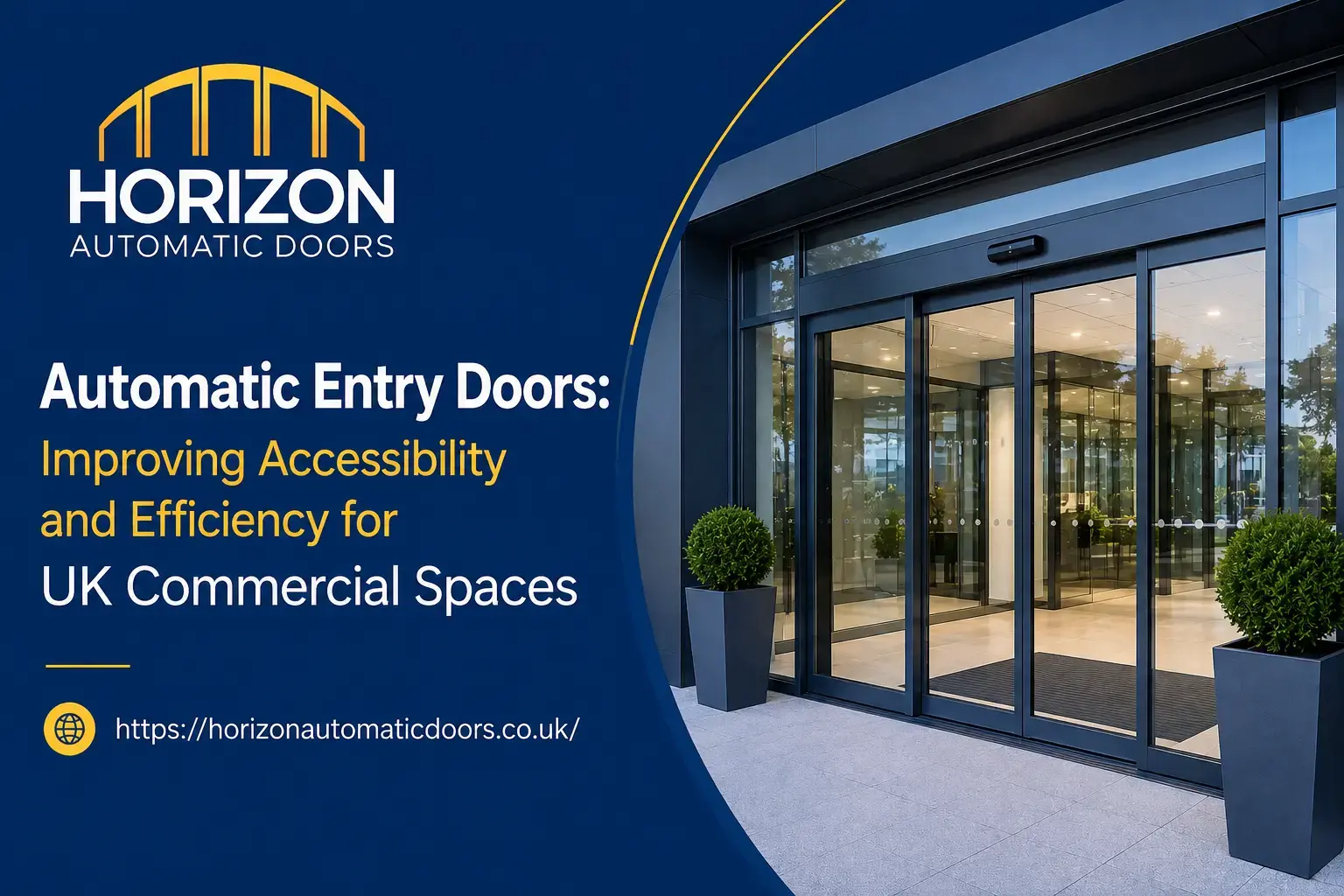
Hundreds of times a day at every busy commercial premises, someone arrives at the entrance carrying something, or moving quickly, or using a wheelchair, or simply expecting the building to work the way modern buildings should.
Whether that moment is seamless or frustrating depends almost entirely on the quality of the entrance system.
Automatic entry doors have moved well beyond the sliding doors of supermarkets and airports, they are now a baseline expectation across the full spectrum of UK commercial, industrial, and public-facing buildings, and the gap between a well-specified system and a poorly chosen one is felt by every single person who walks through it.
Why UK Businesses Are Upgrading Their Entrance Systems?
The case for automatic entry doors in UK commercial settings rarely comes down to a single factor.
More often it is a convergence, accessibility obligations under the Equality Act 2010 that require reasonable adjustments for disabled visitors, energy efficiency targets that demand better thermal separation between interior and exterior, footfall volumes that make manual doors a genuine operational bottleneck, and infection control considerations that have remained relevant in high-traffic public buildings.
For businesses managing all of these pressures simultaneously, the right automatic door system resolves several problems with one investment.
It is a system that will increase the ease of use of the building for people using wheelchairs or pushchairs, as well as those with limited movement, without the need for any staff interaction.
It will reduce the heat lost through the entrance of the building in times of high traffic, as compared to when doors are left open or half open by hand.
Importance of Industrial Automatic Doors
The performance requirements of industrial automatic doors diverge considerably from those of retail or office entrance systems, and conflating the two categories in a specification leads to underperforming installations.
Industrial environments impose challenges that commercial entrance doors are simply not engineered to handle, forklift traffic, heavy goods vehicle proximity, high-cycle frequency that may run to hundreds of operations per day, extreme temperature differentials between warehouse interiors and external loading environments, and the contamination risks of food production, pharmaceutical, or chemical manufacturing settings.
Industrial automatic doors in these contexts are typically high-speed roll or fold systems rather than swing or sliding configurations.
Speed matters enormously, a door that takes four seconds to open and close in a food distribution warehouse represents a meaningful accumulation of cold chain exposure over thousands of daily operations.
Self-repair mechanisms, which allow certain high-speed doors to reset automatically after an impact without requiring an engineer call-out, have become standard on well-specified industrial installations precisely because the cost of downtime in a production or logistics environment far exceeds the modest premium for the feature.
Matching the System to the Building Type
Between the demands of industrial environments and the baseline sliding door of a small retail unit, commercial automatic doors cover a wide and varied middle ground.
Office buildings, health care facilities, hotels, recreational centers, educational institutions, and large retail developments each have different entrance specifications, depending on aesthetics, security considerations, and the legal framework within which the entrances must operate.
Sliding automatic doors continue to be the most popular option in applications where walkins of pedestrians is very high and the size of the opening is critical.
Swing automatic operators suit narrower openings or situations where the existing door frame and threshold are being retained.
Revolving door systems with automatic rotation offer the best thermal separation at premium entrances, hotel lobbies, corporate headquarters, and healthcare buildings where maintaining internal environmental conditions is a priority.
Commercial automatic doors in healthcare settings carry additional requirements around hygiene, touch-free operation, and compliance with HTM 08-01, the NHS guidance on automated doors in health buildings, that require careful specification and, on larger projects, a supplier with demonstrable sector experience.
Accessibility, the Equality Act, and Why It Matters Now
Any UK business or building owner specifying automatic entrance doors in 2026 needs to understand the Equality Act 2010 dimension clearly.
The Act places a duty on service providers to make reasonable adjustments to ensure disabled people can access services, and a manual door that a wheelchair user cannot independently operate is, in most circumstances, exactly the kind of barrier the Act was designed to remove.
This does not mean every building with a manual door is automatically in breach, reasonableness is assessed in context.
But it does mean that when a business is refurbishing an entrance, or commissioning a new one, the argument for specifying automatic entrance doors is not merely a matter of convenience or commercial differentiation.
It is also a question of legal compliance, and the reputational and financial exposure that comes with failing to meet it.
A building’s access point is not an after thought, it is the first practical experience that any individual has of the organization operating from within it.
Entry doors that have been properly specified for the levels of traffic and the nature of the building and its users will ensure the provision of accessible, energy efficient, and fluent operations all at once.
It doesn’t matter whether the specification required is for heavy-duty automatic industrial doors, for commercial automatic doors for a mixed-use property, or for automatic entrance doors in compliance with the Equality Act, it is all the same principle.
Frequently Asked Questions (FAQs)
1. Do automatic entry doors have to comply with the Equality Act 2010?
Yes, in practice, service providers have a legal duty to make reasonable adjustments for disabled visitors, and replacing inaccessible manual doors with automatic systems is one of the most straightforward ways to meet that obligation.
2. How long do commercial automatic doors typically last?
A well-specified and regularly serviced automatic door system should perform reliably for 10 to 15 years; high-cycle industrial systems may require operator replacement earlier depending on daily usage volumes.
3. What is the difference between a sliding and a swing automatic door system?
Sliding systems maximise clear opening width and are best for high-volume pedestrian flow; swing operators suit narrower openings or where an existing door frame is being retained, both can be fully automatic with the right drive and sensor specification.
4. Are industrial automatic doors suitable for food production environments? Yes, high-speed insulated roll doors and clean-room rated fold systems are specifically engineered for food production, pharmaceutical, and other hygiene-critical settings, with materials and seals appropriate for washdown environments.
5. What maintenance do automatic entrance doors require in a UK commercial building?
Quarterly safety checks and annual full-service inspections are standard, covering sensor alignment, operator function, emergency break-out force, and compliance with BS EN 16005, the UK safety standard for power-operated pedestrian door sets.