
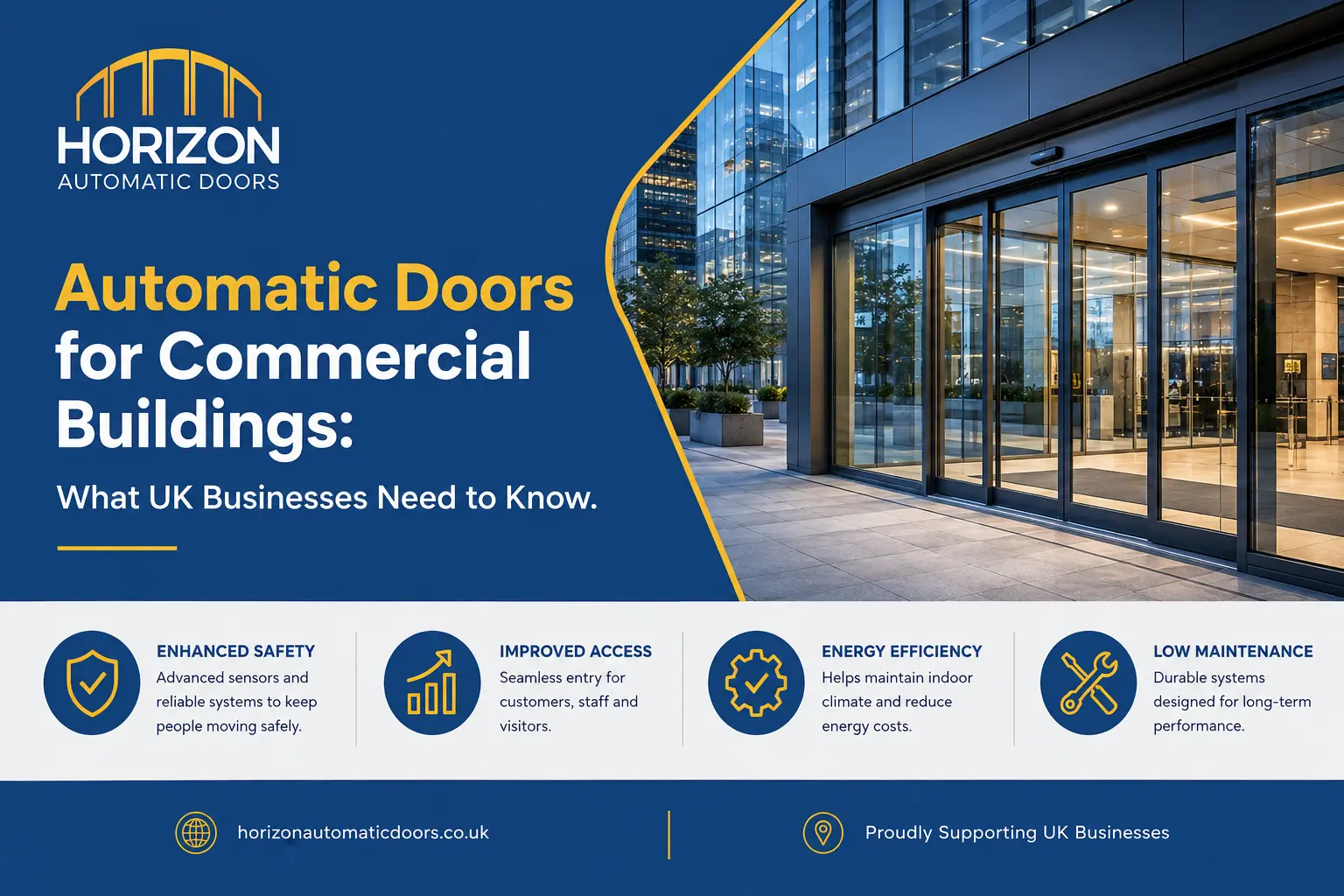
The entrance to a commercial building has a bigger job than simply allowing people in and out. It needs to cope with daily footfall, provide convenient access, support building security, and fit naturally with the way the premises are used.
Automatic doors would be particularly useful for shops, offices, hospitals, hotels and other premises which serve the public because visitors wouldn’t have to force open the door, goods can be transported easily by employees, and busy entrances would be able to cope with a constant stream of traffic without too many disruptions.
It should be noted that not every kind of automatic entrance is equal. The design of the door, available space, traffic conditions, accessibility, security and maintenance should all be taken into account in determining what kind of door is suitable for the specific building.
This guide will cover the practical considerations involved in choosing commercial automatic doors in the UK.
Why Are Automated Entrances Used in Commercial Buildings?
A manually operated entrance may work perfectly well in a small building with limited footfall. However, the scenario is different when many individuals utilize the same entrance door on a daily basis.
Imagine a supermarket entrance door on a busy evening, an office building door in the morning hours, or a health care center door where individuals may experience some movement issues. Manually operating the door becomes annoying after a while.
Thoughtfully designed automated entrance doors recognize the approach of the individual and make the process less physically demanding.
This can be particularly useful for:
- Retail stores and shopping areas
- Offices and corporate buildings
- Hospitals, clinics and healthcare facilities
- Hotels and hospitality venues
- Schools, colleges and universities
- Airports and transport facilities
- Leisure centres and public buildings
In these environments, automatic entry doors are not simply an architectural feature. They can form an important part of how people move around and interact with the building.
Which Type of Automatic Door Suits the Building?
One of the most important decisions is choosing the right opening mechanism. The available entrance space, pedestrian traffic and layout of the property can all influence the choice.
Rather than choosing according to appearance alone, businesses should consider how the entrance will actually function at the busiest points of the day.
Start With Footfall, Not the Door Design
One good technique for designing an automated entrance is determining its users and their frequency. The entrance of a small office building that is mainly frequented by its staff members has different specifications than the entrance of a shopping center.
Installation of commercial automatic doors without taking into account pedestrian traffic may lead to a perfectly designed but poorly functioning entrance during peak times.
Important questions to ask include:
- How many people use the entrance during peak hours?
- Do customers regularly enter with pushchairs, luggage or shopping trolleys?
- Will deliveries also pass through the entrance?
- Is wheelchair access required?
- How much space is available around the doorway?
- Does the entrance experience queues at certain times?
- How will people leave the building during an emergency?
These details give installers and building managers a much clearer picture of what the entrance needs to achieve.
Accessibility Should Be Part of the Initial Plan
Convenient access matters for everyone, but it becomes especially important for people who may find a manually operated door difficult to use.
Wheelchair users, older visitors, people using walking aids and parents with pushchairs may all benefit from automatic doors when they are properly designed and installed.
For UK premises, accessibility should be considered alongside the wider duties and building requirements that may apply to the property.
Sensors Make a Major Difference to Everyday Operation
The visible door panels are only one part of an automated entrance. Sensors and control systems determine when and how the doors operate.
Depending on the system, sensors may detect movement or presence around the doorway. A correctly configured system needs to allow enough time for someone to enter safely without keeping the entrance unnecessarily open.
This is especially applicable to automatic door sensors that are placed in places where children or elderly people come in and out.
The sensor settings must therefore be adjusted according to practical experience and not only on the basis of a hypothetical walking speed.
Can Automatic Entrances Help Reduce Unnecessary Heat Loss?
Every time an external door remains open, indoor and outdoor air can move between the two spaces. In a heated commercial property during a UK winter, repeatedly leaving a manual entrance open may contribute to unwanted heat loss.
Properly configured automatic entry doors can limit the amount of time an entrance stays open because the system closes the door after users have passed through.
This does not mean an automated door automatically makes an entire building energy efficient. Glazing, insulation, draught proofing, opening frequency, door configuration and the building’s heating system also matter.
For heavily used premises, however, controlling how long the entrance remains open can be a useful part of wider energy-management planning.
Safety Is More Than Simply Detecting Movement
Automated entrances combine moving components, sensors, controls and pedestrian traffic. That makes safety an essential consideration throughout the life of the installation.
In the UK, automatic doors should be selected, installed and maintained with relevant safety requirements and standards in mind.
BS EN 16005 addresses safety in use for power-operated pedestrian doors and is an important reference for these systems.
A professional assessment may consider matters such as:
- Detection zones
- Opening and closing speeds
- Safety sensors
- Potential trapping or impact points
- Emergency operation
- Signage where appropriate
- Access around the doorway
- Condition of mechanical components
Safety should continue to be considered after installation rather than being treated as a one-time check.
What Should Be Considered Before Installation?
Before selecting commercial automatic doors, it helps to assess the entrance as part of the wider property.
The doorway width and height are obvious starting points, but surrounding walls, floor levels, electrical supply, glazing and pedestrian routes may also affect installation.
The building’s purpose matters too. A healthcare entrance may prioritise accessible, straightforward movement, while a retail entrance may need to accommodate high footfall and trolleys. An office may place greater emphasis on controlled access and security.
This is why the same door specification will not necessarily suit two buildings of a similar size.
Maintenance Matters After the Installation Is Complete
Automated entrances contain components that experience repeated movement throughout the working day. Sensors, operators, tracks, hinges and other parts can therefore require inspection and maintenance over time.
For heavily used automatic entrance doors, waiting until the system completely stops working is rarely the best maintenance approach.
Routine servicing can help identify issues such as unusual movement, sensor problems, worn components or changes in door performance before they develop further.
Building managers should also pay attention to everyday warning signs. Unusual noises, inconsistent opening, delayed closing or unexpected stopping should not simply be ignored because the door is still operating.
Security and Access Control Can Work Together
Commercial entrances often need to balance easy pedestrian access during opening hours with controlled access at other times.
Depending on the premises, automatic entry doors may form part of a wider access arrangement involving locks, keypads, card readers, intercoms or other authorised-entry systems.
The right approach depends on who needs access and when. A public retail entrance, for example, has different security requirements from a staff-only office entrance.
Planning access control at the same time as the door system can help create an entrance that is convenient during normal use without overlooking security requirements.
A Better Entrance Starts With Understanding the Building
There is no single automated door configuration that works for every commercial property. A busy supermarket, small office, hotel and healthcare centre may all need completely different solutions.
The most effective approach is to consider pedestrian flow, available space, accessibility, safety, security, maintenance and building use together.
When these factors are assessed from the beginning, commercial automatic doors can become a practical part of the building rather than simply another entrance feature.
Similarly, well-planned automatic entrance doors can make movement more convenient for a wide range of visitors, while appropriately specified automatic entry doors can support the everyday operational needs of modern UK commercial premises.
Frequently Asked Questions
1. What types of buildings can use automated doors?
They can be used in many commercial and public buildings, including shops, offices, hotels, hospitals, educational premises and leisure facilities.
2. Do automatic door systems need regular servicing?
Routine inspection and maintenance are important for checking sensors, moving components and the general operation of the system.
3. Which automatic door type is best for a busy entrance?
Sliding and other high-traffic configurations are commonly considered, but the right option depends on available space, pedestrian flow and the building layout.
4. Can an existing manual entrance be automated?
In some cases, an existing doorway can be adapted or fitted with an automated operator. The suitability of the existing door and surrounding structure needs to be assessed first.
5. What should be checked before choosing an automated entrance?
Consider footfall, doorway dimensions, accessibility, safety, security, available space, power requirements and how the entrance will be used throughout the day.